|
|
|
|
|
|
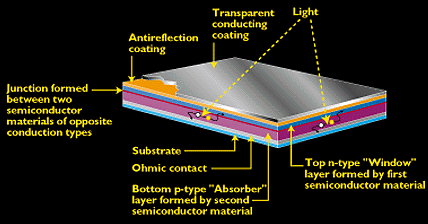
There are 6 main layers of a PV Cell. Without one layer, the whole cell would not work. Each layer must be present in order for the cell to function and produce current. Below is a diagram of a Solar Cell, and below the diagram is a paragraph explaining each main layer.
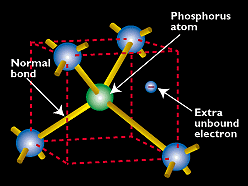
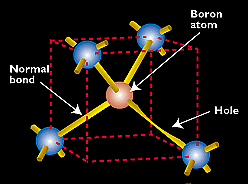
The Makeup of a PV Cell is simple. The sun is the most abundant source of energy that humans have available on earth. Solar Panels can be broken down and are made of smaller units called solar cells, or Photovoltaic cells. These Photovoltaic cells, known as PV cells, convert light energy directly to electricity. Changing the electron configuration of the n-level creates a potential difference and thus forces electrons to create current through a wire. To understand this, one has to understand the makeup of a PV cell. There are six basic layers to a Photovoltaic cell. The top layer consists only of glass, which serves as a protection to the cell itself. Glass is an ideal protection for the Photovoltaic cell because light can pass through it. The second layer is the terminal for the negative side of the solar cell. This level also has to be transparent, since photons must move through this terminal also. Below the terminal comes the n-layer. This n-layer is composed of a Silicon based crystal with Phosphorus impurities. Although the material does not need to be Phosphorus, Boron, or Silicon, these are the most common used and cost efficient. The Phosphorus serves as an acceptor, since the number of Valence electrons in Phosphorus is one more than the bonding needs of the Silicon crystal. Level four is what is called an "n-p junction." This is the area in which the electric field is created after electron transfer. This is an extremely complicated region, and is the most important part of the cell so that energy can be harnessed. Under the junction comes the p-layer. The p-layer is exactly like the n-layer, in that there is the presence of Silicon "single crystal," or a crystal formed with uniform structure. Yet it is different because rather than Phosphorus, it contains an element called Boron, which contains 3 Valence electrons, which is one less electron than the bonding needs of the Silicon crystal. The explainations on why Phosphorus and Boron are used over other atoms is below, along with diagrams.
The fifth layer is another terminal, which is the positive terminal of the cell. The sixth layer is a protective layer, and the final layer needed for a solar cell. Although all of these layers are very complex, the electron flow through them is very logical and can be traced extremely easily. Aside of these six basic layers, many people have advanced further in making the solar cell more efficient. Adding an antireflection layer helps in the absorption of the sunlight into the cell, the shape and design of the cell, and the materials used in each layer all affect the efficiency of the cell. Now that the layers are explained, we can study how the current is created. This is where the logic is applied into the cell. Click here to see how current is created. |