|
Home
Practical Uses
Makeup of a PVC
Creating Current
In The Future
| |
As a photon travels through space and comes into the atmosphere,
only certain photons have enough energy to actually be used by the solar cell. Photons can
do one of three things when they strike a solar cell. First, be absorbed; second, be
reflected; and third, pass through the material altogether. Only the absorbed photons
generate electricity. As one would notice, since only a third of the photons are
absorbed and photons must have a certain amount of energy in order to be used, solar
appear to be inefficient. However since the sun is a constant resource and can be
collected in large amounts, it turns out to be very reliable. As a photon passes through
the glass and hits the n-layer of the solar cell, the photons excite the extra electron
floating in the Phosphorus – Silicon crystal, and cause them to escape the crystal
and move cause a potential difference between the n-layer and p-layer. With the
electron leaving the n-layer and escaping to the top terminal, there is an extra positive
charge on the p-layer, while the n-layer has an extra positive charge. Since there is an
electric field created, to be in equilibrium, the p-layer gives up an electron to fill up
the hole caused by the photon hitting the electron. This, in turn, creates a negatively
charged top terminal, and a positively charged bottom terminal, and thus creates a
potential difference. The electron flows through wires from the top terminal to the bottom
terminal, and causes the voltage to drop to zero. Voltage can be defined as a potential
difference between two charges. Voltage is what causes electrons to flow between two
places. A Voltage is created between the positive terminal and the negative terminal, and
thus electrons flow to do work for us. Each solar cell may be set up in series. Since each
cell operates as a battery, the total voltage will be the sum of each potential difference
along the cells. With the voltage greater, the current will obviously run with more
intensity. Below are some diagrams to help you better understand the process of
Photovoltaic Current.
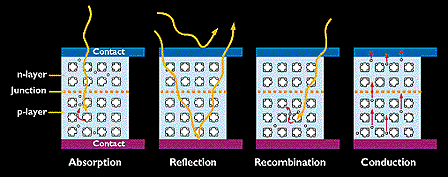
As stated above, only 3 things can happen, and Absorption and Reflection are depicted
here. Conduction (Right-Most) is the most desired.
|
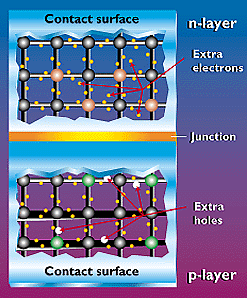
Visual Representation of voids created by the need of electrons in a certain layers.
Electrons from the n-layer cross the junction to fill the voids in the p-layer, and
then leave through the terminal below the p-layer and travel back to the n-layer.
|
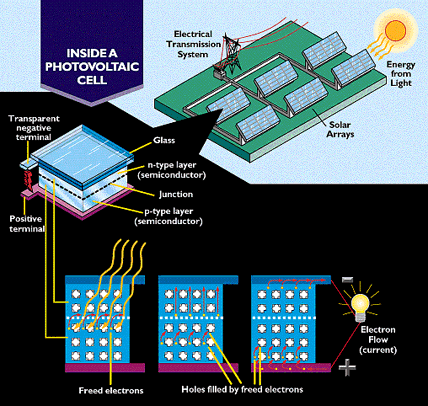
Visual Representation of how current is produced.
|
|




